Getting Started
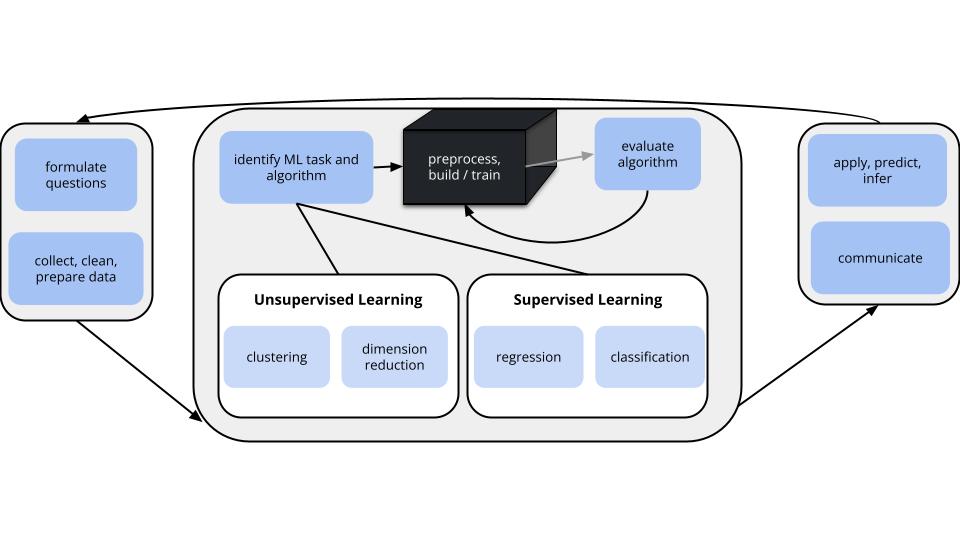
Broadly, statistical machine learning consists of tools and algorithms to learn from data. Insights from machine learning help us take action by enabling us to make predictions and understand uncertainty. Applications of machine learning algorithms are used everywhere from finance to biology, medicine, social sciences, language, and the humanities.
In this course, you will build on the linear and logistic regression modeling techniques covered in STAT 155 to understand tools of regression (Units 1–3) and classification (Units 4–5) more broadly. You will also learn about unsupervised methods (Units 6–7) that can help you find underlying structure in data.
STAT 155 Review
As we build on ideas from STAT 155, familiarity with core concepts from that course is expected.
Check out the STAT 155 Review in the Appendix for a list of important topics that we’ll revisit this semester, as well as links to resources if you need a refresher on any of those topics.
R Setup and Resources
We’ll also be building on your introduction to R/RStudio from STAT 155 (and COMP/STAT 112, if applicable).
TO-DO: During the first week of class, work through the steps on the R and RStudio Setup page in the Appendix to get everything set up for the semester.
Throughout the semester, if you find yourself needing a refresher or additional resources related to R, check out the R Resources page, post questions on Slack, or stop by office hours!
Course Notes
You’ll access most of the materials that you need for this course via this website. Each class period will have its own page on this site. There, you’ll find daily announcements, learning goals, lecture notes, discussion questions, and exercises designed to give you hands-on practice with newly introduced concepts. A corresponding notes template for (most) class periods can be downloaded from the Course Schedule.
On the Schedule, you’ll also find information on what you need to do to prepare for class (eg videos, readings, “checkpoint” quizzes), tasks to work on after class (eg homework assignments), and additional resources to supplement our in-class discussions. Get in the habit of checking this page daily!
Ready to get started?! Head to Introductions for the first day of class!